CARRIE (2026) Developed for television by Mike Flanagan Prime Video Critical Screening Score: 7.1/10
SPOILERS THROUGHOUT
There is no honest way to talk about a new version of Carrie without first asking why it exists. Stephen King's novel has been adapted, remade, continued and turned into a musical. Brian De Palma's 1976 film still works. The bucket is not exactly a secret anymore. At this point it is practically branding.
Mike Flanagan was the reason I did not immediately roll my eyes.
Flanagan understands that adapting King means more than collecting the scenes everybody remembers. His eight-episode Carrie keeps the locker room, the religious mother, the prom and the pig's blood, but its reason for existing is the space between those landmarks. Television gives Carrie White something the movies never had much of: time.
Time is dangerous in Carrie. It means we have to live with the humiliation instead of sprinting toward the part where everybody pays for it.
The first half uses that time very well. This version begins with Carrie still hidden from the world by her parents. Her father Ralph dies in a construction accident, exposing the family's existence and forcing Carrie and Margaret into contact with schools, authorities, jobs and an outside world they have spent years avoiding. That is not restored material from the novel. It is a major invention, but it gives the series a believable reason to make Carrie the new girl at a modern public school.
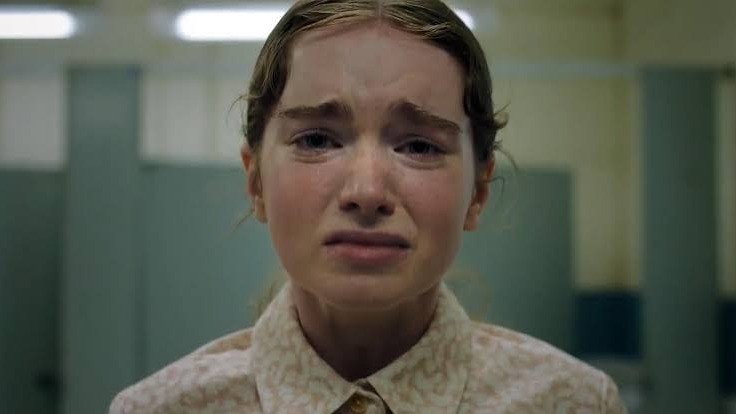
Summer H. Howell plays her as painfully unprepared rather than stupid. Carrie is trying to learn rules that everybody around her absorbed years ago. Every hallway and conversation becomes another test nobody told her she was taking. Howell does not play her like a future monster waiting for permission. She plays a kid who is curious about the world even after nearly every person in it gives her a reason not to be.
Then comes the locker room.
The scene has always been brutal because Carrie genuinely believes she is dying while the other girls laugh at her. Adding phones and social media could have been the cheapest update imaginable. Unfortunately, it makes perfect sense. The original humiliation ended when Carrie escaped the room. Now it can be recorded, uploaded, edited into a joke and delivered back to her by people she has never met. The old scene had walls. This one does not.
The active-shooter drill is another modern addition that could have felt like the show waving a newspaper at us. Instead, it fits the larger anxiety of a girl entering a school where fear has already become part of the daily schedule. Carrie has been taught that the outside world is evil, and public school keeps finding new ways to make Margaret sound almost reasonable. Almost.
Samantha Sloyan's Margaret White is frightening because she does not need to scream every line. She can sound loving while closing the trap. She believes she is protecting Carrie, but every bit of care comes poisoned by fear, control and religious certainty. The quieter moments do not excuse what she does. They make it worse because we can understand how Carrie might confuse possession with love.
Howell and Sloyan hold the series together. The telekinesis matters, obviously, but a floating object is not nearly as upsetting as watching a child look to the person hurting her for comfort.
The first four episodes also benefit from the novel's wider view of Chamberlain. Sue Snell, Chris Hargensen, Tommy Ross, Miss Desjardin and the school staff have time to become people instead of pieces waiting to be moved into prom. The interview and testimony structure recalls the way King's novel assembles the disaster through reports, memories and fragments written after the fact. The series is not strictly faithful, but it initially understands where the book's extra material can make the familiar story feel larger.
At the halfway point, I had the series at a 7.3. It was not radically changing my idea of Carrie, but it was justifying the hours by making the dread last longer.
The second half is where my enthusiasm slipped.
Episodes five and six continue much of what works. Carrie begins pushing back against Margaret, the pressure at school becomes harder to contain and the adults keep proving that recognizing a problem is not the same as stopping it. The performances remain strong, and the series still understands that home and school are not opposing worlds for Carrie. They are two different traps.
By the final two episodes, however, the show becomes less interested in expanding Carrie and more interested in expanding beyond her. Emaline is revealed as part of a much larger world of psychically gifted women. Adelaide and her group have been watching Carrie, while another faction sees girls like her as a threat. The supposed documentary interviews turn out to be part of that operation. What began as a clever way to use the book's fragmented structure becomes the doorway into a larger mythology.
There is a basis for some of this in King's novel. The book suggests that Carrie is not the only girl with these abilities, and Flanagan has been open about wanting to follow that thread much farther. Stephen King approved the approach. That settles whether the series had permission to do it. It does not automatically settle whether it improves this particular story.
For me, this is where the adaptation becomes less effective.
The prom is still tense and the pig's-blood moment still lands, partly because the series has spent hours making Carrie hope the night might actually be good. Tommy's death freezes her. Carrie then allows Emaline to take control, and Emaline drives much of the massacre while Carrie remains present inside her own body. Carrie takes control again for Chris and Billy, so the series does not remove her agency completely, but it does redistribute the guilt.
I understand the idea. Flanagan does not want the story to end with Carrie reduced to a monster, and tragedy usually has more than one author. Margaret, Chris, Billy, the school, the internet and every adult who failed to stop the situation helped build what happens at prom. The problem is that Carrie has always been most disturbing when victim and perpetrator collapse into the same person. We understand exactly why she breaks, and then we still have to sit with what she does.
Putting Emaline behind the wheel for so much of the destruction softens that conflict. Carrie remains traumatized and involved, but the series gives us another place to put the blame. It protects her at the exact moment the story should become hardest to process.
The same issue follows the final confrontation with Margaret. Their relationship has been the emotional center of the season, but Adelaide's intervention helps determine its ending. The scene still has weight because Howell and Sloyan have earned it. I just wanted the conclusion to belong more completely to the mother and daughter who spent eight episodes building toward it.
Then Carrie survives.
I can appreciate that choice. After spending this much time with her, simply marching Carrie toward the same death again could have felt predictable and unnecessarily cruel. Her escape with Emaline is one of the few endings an adaptation has not already tried. It also makes the season feel like the beginning of another story rather than the end of this one.
That is clearly intentional. Flanagan has discussed a larger plan, and the final episodes leave Carrie, Emaline, Adelaide and the competing psychic groups ready to continue. I am interested enough that I would watch another season. I am also not convinced that Carrie needed to become the entrance to a larger universe.
The first half made an old story feel lived in again. The second half started looking past that story toward what else it could build. There are good ideas in both approaches, but they do not carry the same emotional weight. I prefer Carrie White to the Carrie universe.
The full season is still effective. Howell and Sloyan are excellent, the modernized bullying creates real anxiety, and Flanagan finds enough new material to justify revisiting a story that did not exactly need rescuing. I had the first four episodes at 7.3 and the last four at 6.8. Split the difference and the season lands at 7.1.
Good, occasionally great and more thoughtful than another piece of recycled intellectual property had any obligation to be. I just wish the ending had trusted the tragedy in front of it as much as it trusted the possibilities waiting beyond it.
7.1/10