Spoilers throughout.
It takes a peculiar kind of movie to drop an American suburb into prehistory, surround a family with dinosaurs, and still become boring.The End of Oak Street manages it.
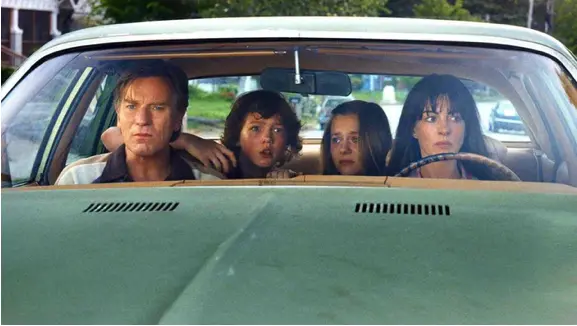
The premise should be nearly indestructible. A fractured family wakes up to discover that its ordinary neighborhood has been ripped out of 1982 and deposited in a world full of prehistoric animals. Their domestic problems have suddenly become very small, while everything outside their front door has become very large. That contrast contains the entire movie: private resentment colliding with primal survival.
Writer-director David Robert Mitchell gets flashes of pleasure from that idea. There are moments when the movie is funny, nasty, and genuinely entertaining. The sight of prehistoric life pushing into a bland suburban neighborhood has an immediate B-movie charge, and a few of the creature encounters briefly deliver the movie promised by the premise. Anne Hathaway commits to the danger with enough force to make even the shakier material feel urgent.
Then somebody starts talking.
The dialogue is less conversational than explanatory. Characters do not reveal themselves so much as announce what the screenplay needs us to know about them. Denise is writing a thinly disguised novel about abandoning her family. Greg discovers it, allowing their marital crisis to be stated aloud. Audrey's interest in Carl Sagan and theoretical science becomes a portable exposition device once the film needs someone to explain wormholes. Emotional conflict, backstory, and plot mechanics are repeatedly delivered as information.
This is not simply a matter of dialogue being clumsy. It affects the entire dramatic structure. When exposition is also expected to do the work of characterization, neither function lands. We understand what each person represents, but we rarely feel the private life beneath the representation. The family members resemble pieces arranged for a story about reconciliation, not people whose behavior might make reconciliation necessary or difficult.
That thinness becomes more obvious because the film keeps introducing plot elements it has no real use for. Brian has accidentally broken another boy's arm, and the injured kid's older brother is looking for him. This seems designed to become a meaningful test once the neighborhood collapses. Instead, the older boy attacks Brian during the dinosaur crisis, realizes he has gone too far, admits that he is frightened, and then disappears from the story.
The scene technically concludes the encounter, but conclusion is not the same as payoff. Brian does not appear changed by it. The bully does not become an ally, a casualty, or even a meaningful contrast to the family. The broken arm could be removed without altering the spine of the movie. It feels like a surviving setup from a version of the screenplay in which that relationship mattered.
Jeanette has a similar problem. After apparently losing her parents, she joins the Platt children and is absorbed into their escape. Her presence should complicate the film's central idea of family. She has just suffered the loss that the Platts spend the movie fearing, yet the screenplay gives her little interior life and almost no effect on the family's relationships. She becomes another body to move through the action. The film introduces dramatic possibilities faster than it can develop them.
This is why The End of Oak Street feels rewritten, not merely underwritten. Its parts seem to belong to different priorities. One passage wants a domestic drama. Another wants an Amblin-style children's adventure. Another wants a nasty creature feature. Another wants a broad comedy. None of those movies is inherently incompatible with the others, but Mitchell never finds the dramatic cause and effect that would make them feel like one film. The ingredients accumulate instead of transforming one another.
There is some evidence behind that impression. Hathaway has said that the screenplay changed several times between her signing on and the beginning of production. Most significantly, Greg originally died and remained dead. His return was added very close to filming, according to Hathaway's account in Entertainment Weekly.
That change is visible in the finished film. Greg's death is one of its few genuinely startling decisions. It is abrupt, ugly, and cruel in a way that briefly gives the danger consequence. Then the time-travel mechanism returns the family to an earlier point, allowing Denise to call Greg and prevent his death. Most of the neighborhood's casualties are similarly erased.
There is nothing automatically wrong with giving a family adventure a happy ending. The problem is that the film does not resolve its losses. It cancels them. Greg is not restored because the family has repaired something in a dramatically meaningful way. He can be summoned through the pizza-delivery job established earlier, almost as if the screenplay has discovered a coupon for resurrection. The plot closes a loop, but the emotion inside that loop has been emptied out.
It is tempting to wonder why an actor with Hathaway's stature did not demand that certain scenes be rewritten or reshot. But a movie star is not automatically the author of the movie. Hathaway can question a decision and bring enormous influence to a production, but she is still performing material controlled by a writer-director, producers, a studio, and eventually an edit. More importantly, a few replacement line readings would not solve what is wrong here. You can reshoot a line. You cannot reshoot the reason a scene exists without rebuilding everything around it.
Hathaway is still the strongest presence in the film. She supplies fear, anger, and resolve even when the screenplay has not built enough space between those emotions. Ewan McGregor fares worse. Several of his line readings have an uncertain cadence, as though he is still searching for the tone of the scene while the camera is already rolling. The younger performers are uneven, and supporting characters often appear to be acting in different versions of the same movie.
Calling all of that "bad acting" is not entirely wrong, but it is incomplete. Performance is created by acting, writing, direction, coverage, and editing together. When talented performers seem stranded, the useful critical question is not simply who acted badly. It is what the production failed to give them. Hathaway can lend conviction to weak material, but she cannot manufacture connective tissue that was never written or preserved in the cut.
The frustrating thing is that The End of Oak Street occasionally proves it could have worked. When the explanations stop and the movie lets physical space, absurdity, and danger carry a sequence, it comes alive. Some jokes land. Some attacks are exciting. The collision between tract housing and prehistoric violence remains a great image.
Those moments are not enough. The bad outweighs the good, and the scattered pleasures cannot disguise a screenplay filled with abandoned threads, mechanical payoffs, and dialogue that explains more than it reveals.
5.1/10. The extra tenth belongs to Anne Hathaway, who keeps pulling scenes toward a better movie that never quite arrives. The End of Oak Street is not a complete disaster. A disaster might at least feel decisive. This feels like several potentially interesting movies that survived the same rewrite and never learned how to live together.