DIGGER (2026) Directed by Alejandro G. Iñárritu Released October 2, 2026 Critical Screening Score: 6.6/10
SPOILERS THROUGHOUT
Viewed theatrically at the Illinois Theatre in Jacksonville, Illinois.
Tom Cruise is outstanding in Digger. That is the easy part. The harder part is explaining why a movie this strange, expensive and visually alive left me more frustrated than excited.
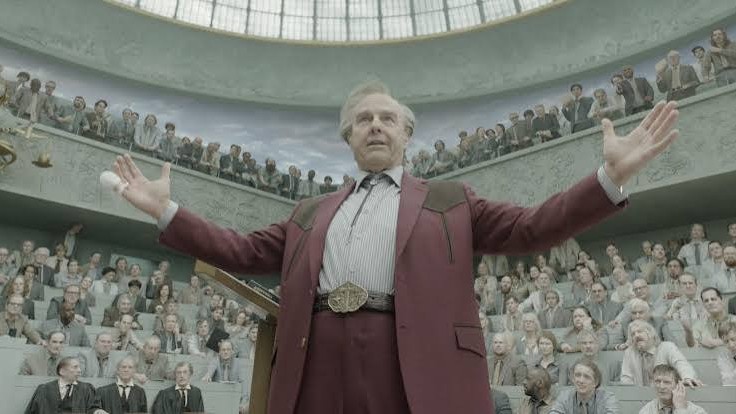
For a while, I was ready to follow Digger Rockwell anywhere. Cruise disappears into the white hair, the gut, the Southern drawl and the rotten confidence of a billionaire oil baron who thinks being powerful is the same thing as being right. Digger has helped cause an environmental catastrophe, but he still sees himself as the only man capable of saving everybody from it. Of course he does. A man like this does not look in the mirror and see the problem. He sees the only adult left in the room.
Cruise is having a hell of a time playing him. The performance is broad, but it is controlled. He never turns Digger into a collection of prosthetics and noises. There is a real man beneath all that expensive decay, which somehow makes him worse. Digger is ridiculous, disgusting, charismatic and just human enough that I wanted the movie to stay with him while the consequences of his greed closed in.
There is also something smart in casting Cruise here. He has spent decades playing men who can fix impossible situations through preparation, nerve and forward motion. Digger has the same absolute faith in himself, except now that faith is diseased. He helped build the disaster and still believes his confidence qualifies him to become its hero. Cruise is using the machinery of a Tom Cruise performance against us, and he is very good at it.
The setup is direct. Digger's company ignores the warnings and continues drilling in Greenland. The resulting explosion breaks loose an enormous ice shelf and sends Europe toward catastrophe. The United States government, led by John Goodman's President Compson, begins considering increasingly desperate answers while Digger tries to turn the end of the world into one more opportunity to prove his importance.
That movie works for me. It is ugly, funny and ridiculous in a way that feels close enough to reality to be uncomfortable. Iñárritu does not whisper the satire, and I do not think he intends to. These are people who would hold a press conference beside the crater and congratulate themselves for bringing shovels.
Emmanuel Lubezki gives the movie its own visual life from the beginning. Shot principally in VistaVision with wide vintage Leica lenses made for the production, Digger has scale without feeling like anonymous blockbuster coverage. The rooms have depth. Faces and bodies take on slightly warped dimensions when the camera gets close. Digger can seem enormous inside a frame and pathetic within the same shot.
Lubezki has made plenty of beautiful images, but beauty is not really the point here. The photography makes the world feel unstable before the story openly admits how unstable it is. The camera moves through private rooms, government spaces and public spectacle as if everything belongs to the same diseased organism. Even when the movie gets muddy, it never becomes visually generic.
Then a tree falls.
Digger and Compson barely react. A director calls cut. A hand comes out of the ground and puts the tree back where it belongs. The world we have been watching is revealed as an elaborate theatrical production called Fossil Fools. Cruise is not actually Digger Rockwell. He is Curtis Markson, an actor playing Digger in a satirical recreation of a catastrophe that occurred twenty-five years earlier.
I admired the twist. I did not see it coming, and the reveal itself is staged with confidence. It does not feel like a cheap bit of withheld information. The movie changes shape in front of us and asks a more difficult question: What good is satire after the disaster has already happened?
Unfortunately, I also wanted my ridiculous Digger movie back.
That is where the frustration settled in and never completely left. The first half gives us this grotesque character and lets Cruise make him magnetic. Then the movie pulls him away and replaces him with Curtis, the production, the people financing it and a larger argument about whether art can expose power or merely make an audience feel intelligent for recognizing it. Those are worthwhile ideas. They are not as alive as Digger Rockwell.
The twist also changes Cruise's performance in a way I found intellectually interesting but emotionally distancing. We are now watching Cruise play Curtis playing Digger, sometimes while Curtis is distracted by the disappearance of his daughter. That requires a lot from Cruise, and he delivers it. I could see the layers. I could admire the technique. I still missed the bastard from the first half.
Maybe that loss is intentional. Digger is a performance, satire is a performance, public concern can become another performance, and the real world continues rotting outside the theater. I understand what the movie is doing. Understanding it did not make the second half less muddy for me.
The problem is not that I could not follow the plot. The problem is that the emotional center keeps moving. Jesse Plemons enters as Kenny Rockwell, the real Digger's nephew and one of the people behind the production. Curtis is dealing with his daughter. The company is preparing for the live performance. The movie keeps widening its argument when I wanted it to cut deeper into the one it already had.
There are good scenes throughout this section, and Cruise never stops working. The cast is loaded with actors who know how to survive inside an Iñárritu movie, including Plemons, Sandra Hüller, Riz Ahmed, Michael Stuhlbarg and Goodman. Nobody embarrasses themselves. The movie simply becomes more interested in the machinery around Digger than in Digger himself.
The final reveal helps. The world outside the production has not recovered. The air is bad, the streets are flooding and people are moving through a damaged society while the cast celebrates another successful performance. Art has explained the catastrophe, mocked the people responsible and given everybody a temporary emotional release. It has not repaired anything.
That ending is bleak and effective. It also clarifies why the movie had to become something larger than a character study. I can admire that choice and still feel the character study was the better movie. Both things can be true. Digger is bold enough to create that argument inside me, but not precise enough to resolve it.
Now for the part that makes me angry for reasons beyond the movie itself.
Digger opened to roughly $8 million domestically against a reported production budget of at least $125 million. That is a bust. I understand that movie tickets are expensive and audiences do not owe a studio their money simply because something is original. Originality is not charity, and this movie is difficult, divisive and far from perfect.
Still, I get tired of hearing people complain that Hollywood only makes sequels, remakes and recycled intellectual property, then watching an original movie from a major filmmaker and one of the last genuine movie stars die in mostly empty theaters. I saw it at the Illinois Theatre in Jacksonville. It was there. People just did not come.
Studio executives will not learn the thoughtful lesson from this. They will not decide the next original film should cost less, be marketed more honestly or have a cleaner second half. They will look at the number and decide originality was the problem. Then another recognizable title will get dragged out of storage, wiped off and forced to dance again. The same audience will complain that nobody takes chances anymore.
Shame.
I was slightly disappointed by Digger, but disappointment is not the same thing as dismissal. The movie frustrated me because it showed me a version of itself that I loved, then deliberately became something else. It is ambitious, visually distinct and anchored by one of Tom Cruise's best recent performances. It also gets tangled in its own ideas and loses some of the filthy energy that made its first half work.
It should still be watched. I would rather wrestle with a movie like Digger than forget another perfectly functional franchise installment before I reach the parking lot. This is an original swing from serious filmmakers with real resources behind them. It misses often enough to hurt, but at least it leaves a bruise.
6.6/10