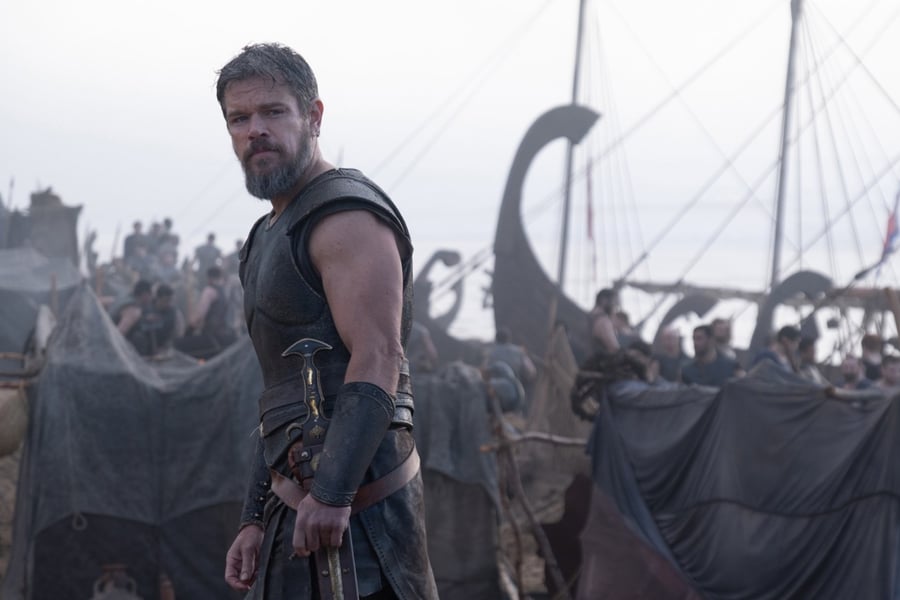
There are two ways to talk about Christopher Nolan's The Odyssey. As a movie, it is impressive but uneven. As evidence of what modern studio filmmaking can still accomplish, it is close to miraculous. Both things can be true.
I am not a Nolan fanboy. There are several of his movies I admire more as feats of engineering than as drama, and a few I could comfortably live without seeing again. What I do admire, consistently, is his devotion to the physical medium of film and his insistence that theatrical filmmaking should remain an event.
When he hits, he hits. The Odyssey is a hit.
It is also a 7.7.
That number is not a contradiction. A massive production can be historically significant and still contain stretches that drag. A filmmaker can push the medium forward while making choices that keep the individual film from greatness. Respect for the undertaking should sharpen criticism, not replace it.
The scale is undeniable. Nolan and cinematographer Hoyte van Hoytema take the production onto real coastlines and real water, and the movie has a tactile weight that expensive contemporary filmmaking often lacks.
The superlatives belong to the Trojan Horse sequence. Nolan makes one of the most familiar images in Western mythology unfamiliar again by treating it as a problem of weight, breath, water, space, and timing. Inside, soldiers are packed against unfinished wood while the water rises around them. An idea that usually exists as an illustration becomes a physical ordeal.
What follows is the film's most complete fusion of spectacle and storytelling. The siege has size, but it also has clarity. We understand the plan, the geography, the vulnerability of the men inside, and the terrible consequence of their success. The enormous image never becomes an empty image.
Nolan also finds a distinct approach to Homer's story. The gods are pulled closer to psychology, memory, and guilt. The journey home becomes more than a series of monsters blocking a hero's path. It becomes the moral afterlife of war.
That moral afterlife becomes literal in the descent into Hades, one of the film's most extraordinary passages. Large-format photography is usually discussed in terms of breadth: landscapes, armies, ships, and physical scale. Here van Hoytema uses that scale to express isolation.
The Trojan Horse demonstrates what Nolan can build. Hades demonstrates what he and van Hoytema can make us feel. Together, those sequences justify nearly every superlative attached to the production.
Unfortunately, the movie does not sustain the force of that idea across its entire running time. The middle drags. The episodic trials begin to form a pattern of arrival, ordeal, loss, and escape. Individual passages contain extraordinary images, but their dramatic effect starts to flatten when placed one after another.
The movie does not necessarily need to be dramatically shorter. It needs to feel as if every minute is tightening the same rope. During the middle, that rope occasionally goes slack.
Then there is Matt Damon. Damon is not bad. He is physically credible, emotionally legible, and capable of carrying the exhaustion of a man who has spent years watching his decisions kill the people around him. But Odysseus is supposed to be dangerously intelligent, persuasive, deceitful, arrogant, and resourceful enough to bargain with monsters and outthink kings.
Damon's great strength has always been his recognizable humanity. Here, that familiarity sometimes works against the character. He gives us a sturdy man enduring an impossible trip, but not always the cunning, volatile presence whose mind should be as formidable as anything the production puts in his path.
Still, I would rather contend with the imperfections of The Odyssey than watch another expensive movie designed to evaporate the moment it ends. Nolan has made something with mass. You can feel the wood, water, stone, smoke, bodies, and distance.
7.7/10.
The Odyssey is a monument, but not quite a masterpiece.